PGL Major Singapore 2026: Valve's VRS Rule Change Explained — The BCGame and Sashi Region Swap Controversy
Valve has closed a controversial loophole in the Valve Regional Standings (VRS) system less than two months before PGL Major Singapore 2026, transforming what was already a competitive qualification race into one of Counter-Strike's most heated integrity debates in years.

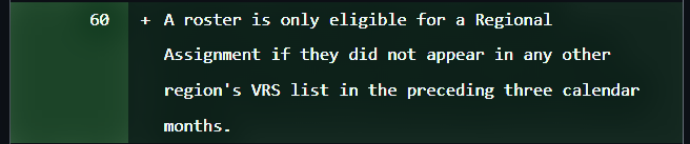
The new rule prevents teams from receiving a regional assignment if they appeared on another region's VRS list during the preceding three calendar months — directly targeting late moves designed to improve Major qualification chances.
The rule applies immediately to Singapore, but its mid-season introduction has raised serious questions about fairness and consistency, particularly for teams that had already switched regions before the change was announced.
What Valve's New VRS Rule Actually Says
Under Valve's updated Major Supplemental Rulebook, the relevant section now reads:
"A roster is only eligible for a Regional Assignment if they did not appear in any other region's VRS list in the preceding three calendar months."
The change introduces a waiting period for teams attempting to switch VRS regions. A roster cannot change its regional identity shortly before the Major invitation cutoff and immediately benefit from a new region's allocation. The rule applies specifically to Major invitations — teams can still receive invitations to non-Major VRS events despite being affected by the restriction.
Valve also clarified that the three-month period is measured against the point when Major invitations are issued, not the start of the tournament itself. The PGL Major Singapore 2026 runs from November 25 to December 13, with the VRS invitation cutoff set for November 2.
Why Region Swaps Became So Attractive Before PGL Major Singapore 2026
The controversy stems from VRS qualification being split between Europe, Americas, and Asia — with each region receiving a different number of Major spots. Europe receives 18, Americas receives 9, and Asia receives just 5.
BCGame showed exactly how valuable a regional move could be. After signing Tyson "asap" Paterson in September, the team gained an Asian-majority core alongside Senzu and mzinho. BCGame's 1,191 VRS points placed them 39th in Europe — but the same points would have ranked them fourth in Asia, where only five Major spots were available. The move was allowed under existing rules, but it immediately demonstrated how easily teams could use regional assignments to improve qualification chances without a long-term presence in a region.
The Sashi Move That Broke the Camel's Back
The situation escalated on October 5 when Danish organisation Sashi announced the temporary additions of Australian players Tynan "TjP" Purtell and Jordan "Hatz" Bajic. With Anton "Anlelele" Huynh also identified as holding Vietnamese citizenship, the roster could qualify for an Asian regional assignment — opening a path to one of the five available Asian Major spots despite Sashi traditionally competing in Europe.
Crucially, Sashi made clear the move was temporary, with Mikkel "MistR" Thomsen and Casper "Cabbi" Jensen stepping out of the starting lineup for the coming month only. The timing, just weeks before the November 2 invitation cutoff, made the move particularly controversial.
The backlash was immediate. Nikola "NiKo" Kovač publicly called on Valve to intervene, while other players questioned whether teams should be allowed to temporarily reconstruct rosters purely to access a different regional qualification pool. The criticism was not simply about whether the move followed the rules — it was about what the rules were allowing teams to do.
BCGame vs Sashi: Why They Are Not the Same
One of the most important distinctions in the debate is that BCGame and Sashi were not making identical moves.
BCGame changed one player and already had Senzu and mzinho in the roster before the switch — its Asian core was not created entirely from scratch immediately before the cutoff. The organisation also presented asap's signing as a longer-term move.
Sashi, by contrast, made two temporary additions and explicitly stated that two existing players would step out for one month only. The organisation also relied on Anlelele's Vietnamese citizenship to satisfy the regional requirement — a circumstance that BIG co-founder Tom J. Lemke later described as the "straw that broke the camel's back," citing a conversation with Valve directly.
That distinction became central to the community debate and ultimately to Valve's decision-making.
Valve's Response and the BCGame Exception
Valve's rule change arrived just two days after Sashi's move became public, confirming it would apply to the PGL Major Singapore 2026 and that affected teams were "currently disqualified from the Major run" unless they reached out and found a solution.
BCGame responded with a proposal from CEO Ali "Ako" Muhanned — rather than asking Valve to restore its existing ranking, BCGame offered a full reset to zero VRS points, asking only to be allowed to compete from scratch:
"Start us from zero. Let us play. Let the server decide. 0 points. 5 players. 3 weeks. If we fail, we stay home. If we make it, we earned it."
On October 7, Valve granted BCGame an exception. The lineup of asap, Magisk, mzinho, s1mple, and Senzu was confirmed as assigned to the Asia region and eligible for a Major invitation — keeping their existing VRS points intact. BCGame currently sits No.1 in the Asian VRS, putting them in a strong position to secure a PGL Major Singapore 2026 invitation ahead of the November 2 cutoff.
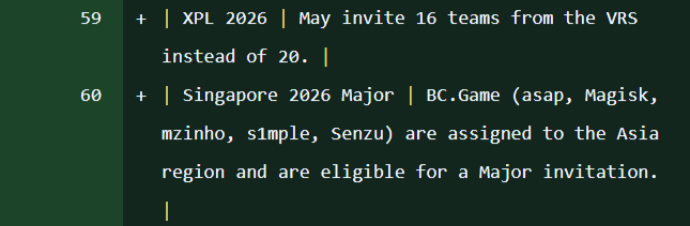
The ruling also confirmed that Valve's three-month rule is not absolute, with exceptions available depending on a roster's circumstances — a detail that will shape how teams approach regional strategies for future Majors.
Why Asia Feels This Controversy More Than Other Regions
The backlash around the PGL Major Singapore 2026 VRS controversy has been stronger than a typical roster transfer dispute, and for good reason.
Asia has only five Major positions compared to 18 for Europe and nine for Americas. That means every Asian VRS position carries significantly more weight, particularly for teams that have spent the entire year competing within the region.
The October 7 VRS standings illustrate the point clearly — TYLOO, The MongolZ, and 5STAR led the region, followed by Lynn Vision and JiJieHao, in a competitive pool that is shallower than Europe's deep ecosystem.
A European organisation entering Asia for a few weeks does not simply gain a different ranking position. It potentially occupies a spot that an established Asian team has been building toward all season. Regional spots should reward teams developing within the region — not those most capable of exploiting the VRS structure.
What Happens Next for PGL Major Singapore 2026
The PGL Major Singapore 2026 will be the first real test of Valve's new approach. The 32-team Major runs from November 25 to December 13, with the VRS invitation cutoff on November 2.
For BCGame, the exception is confirmed but the Major spot is not guaranteed — they must still earn it through the Asian VRS rankings. For Sashi and WW, a resolution with Valve is still needed. For the wider Counter-Strike scene, the bigger question is whether the three-month restriction can establish a sustainable standard for future Majors without creating new inconsistencies of its own.
The rule closes one of the most obvious loopholes in the VRS system. Whether it can also protect the regional identity and competitive ecosystem that Valve wants the rankings to represent is a question only Singapore will answer.